Estwing 16 oz Smooth-Face Hammer
A smooth face and a one-piece forged handle, so you can hang trim, set cabinets, or drive a picture hook without leaving a waffle print on the wall or a loose head on the hammer.
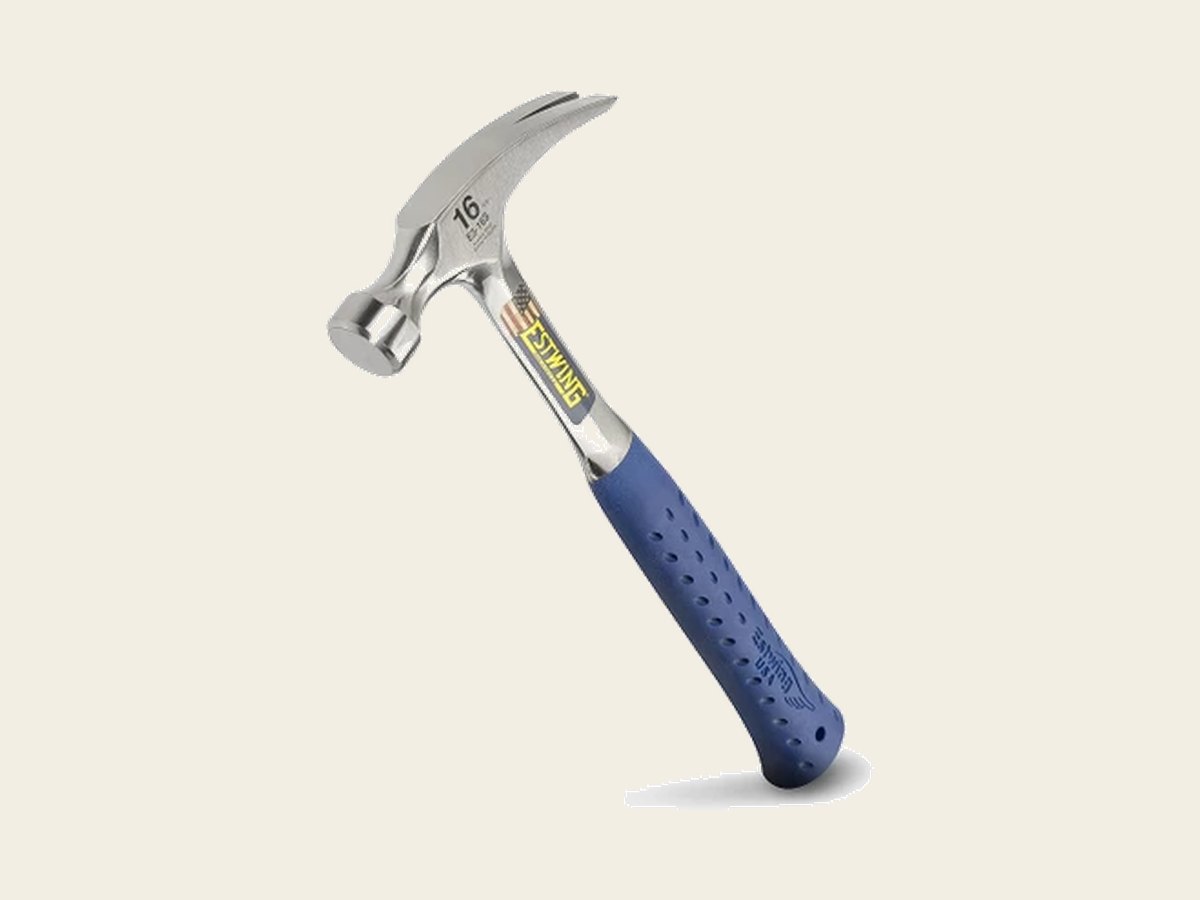
Spec check
| Head weight | 16 oz |
|---|---|
| Face | smooth (the S in E3-16S) |
| Construction | one-piece forged steel head and handle |
| Claw | straight (rip) |
| Grip | bonded shock-reduction vinyl |
| Made in | Rockford, Illinois |
This is the hammer for inside the house. Trim, cabinets, door casing, hanging pictures, the baseboard that popped loose. Work where the hammer gets close to a finished surface and a miss leaves a mark you have to explain.
Why the smooth face
Framing hammers have a milled face, a waffle pattern that grips the nail head so you can swing hard and sloppy. It also stamps that waffle into drywall, trim, and cabinet faces when you miss. A smooth face slides off a miss and leaves a lot less behind. It will still ding paint; it will not leave a pattern.
Why one piece of steel
Most hammers are two parts pretending to be one. The head is held onto a wood or fiberglass handle by a wedge, an epoxy, or hope, and every miss-hit works that joint a little looser. The Estwing is forged as a single piece. There is no joint because there is no second part. That is why these show up in fifty-year-old toolboxes still doing their job.
Why the straight claw
The curved claw on a finish hammer pulls nails with better leverage. The straight claw is a pry bar first: it slides behind trim you are tearing out, under a board, into a tight spot. For house work, you pry more than you pull. Get the straight claw.
What the grip actually does
Steel handles ring. Estwing bonds a vinyl grip onto the handle that takes the edge off. The grip is the part that eventually wears; the handle under it does not.
The verdict
If you own one hammer and most of your swinging happens indoors, this is the one. It will not wear out, the head will not come off, and it does not leave evidence.
Skip it if
You are framing a house or building a shed. A milled face bites the nail head and a 20 or 22 oz head drives 16d nails in fewer swings. Estwing makes both with the same one-piece handle.